I recently returned home to Israel after a visit of about two weeks in the US1, and things were a little weird there.
I am writing this on Friday, 26 July 2024; day 294 in the war against Ḥamas, Ḥezbollah, and other terrorist government organizations; Stardate -298433.0601. Despite knowing that nobody will read this until considerably later, and so it’s going to be a bit anachronistic then, I still want to capture some observations about being in America right now while they are still fresh on my mind. Because the future of the next era in that nation is being written right now.
You may be wondering why I said things were a little weird in the grand old USA, nearly 250 years old. It’s just my impression based on my lifespan and study of US history.
For those who don’t know me, I grew up in the US South until my late 20s, and then made aliyah (i.e. moved to Israel) in 2003. There’s always been a little reverse culture shock the dozen or so times that I’ve gone back to visit the US since then. But on this particular occasion, I couldn’t help but feel like a lot of otherwise well adjusted Americans are losing their minds.
Overall, it was an amazing visit, better than most of the previous ones. I want to emphasize this at the outset so that what follows doesn’t appear to be the gripe session of an expat American. It was a short, but highly enjoyable trip with several stops. I visited my mother in the home where I grew up. I spent Shabbat in the home my best friend since junior high, whom I refer to unironically as my consigliere. Then I spent the final week in the corporate offices of the company that I’m contracting for full time nowadays. And in a wonderful synergy, being there allowed me to spend my off time in the Jewish community in Atlanta, which is basically my second home and where I learned the true sense of community.
To finish off the visit with style (« pour clore en beauté » is the French expression I’m thinking of), I spent two and a half days camping out in various airports, waiting for flights that were being delayed numerous hours or ultimately cancelled, and dining on the finest kosher protein bars and trail mixes, while the CrowdStrike outage of Friday, 19 July 2024, continued to wreak havoc on flight crews and their schedules several days later.
Despite the last few stressful days, I was able to make great use of the time, and focus on the positive. I mention this only because some of my visits back to the US consist of too much time spent in environments that are steeped in horrifically bad memories. An Israeli friend in America used to give me this advice about going back home: “Don’t be a frog.“
What did he mean by that? Well, he was not using the derogatory British nickname for the French, which has never funny but somehow seems to stick around, especially among people who don’t know any French.
Frogs have highly permeable skin that absorbs water, obviating the need to drink it. Consequently, they also easily absorb bacteria, chemicals and other toxins. According to the Science X news hub from Isle Of Man, “These traits make them susceptible to changes in the environment and great indicators of their environment’s health,” making them an indicator species. What my Israeli friend was trying to say is, when going into an emotionally unhealthy environment, don’t absorb all the misery that’s around you. Don’t let it make you sick. For him, it was the poverty-stricken neighborhood in Jerusalem where he grew up, whereas for me it’s around a certain city in Georgia, which I shall describe in more detail in another entry on this site.
There is a sickness that seems to have infected the entire United States of America since I left, resulting in pockets of toxicity everywhere.
I slowly became aware of it during the 2020 US Presidential election campaign. I wasn’t there physically, but I was spending too much time on social media. Mind you, I had been active on Facebook since working for a major news during the 2008 campaign, following the lives of friends and acquaintances in a mostly healthy fashion. I was following US and world news very closely, while still feeling comfortably isolated from goings-on over there. Likewise in 2012, while no longer working in journalism, I followed the major news events, but still didn’t feel personally involved. My life was in Israel, and it was largely Israeli society and events that affected my life. So I jokingly referred to obsession about US elections as “provincial politics”.
That was then. In 2020, however, the political atmosphere that I saw happening in America, and the statements that I saw people making on social media, led me to the decision to quit using Facebook altogether. It was starting to adversely affect my health, especially as I saw people whom I cared about turn into angry combattants who were engaging in some really ugly debates.
Isolationism wasn’t possible anymore. The political camp that I used to identify with, back when I was a naïve and idealistic high school and college student, was becoming unrecognizable. And the more holistic political approach that I took while transforming my life with the Jewish religion no longer helped, as there was massive infighting even within the Orthodox community.
I feel like I’d better lay out the following before getting to my point about the state of US politics today, in July 2024.
When I was young, my opinions were, of course, a product of my staunch Christian home and Christian school environment. By high school, I tended to agree with what was being taught overtly: the guiding principles of the Republican party, since they seemed to line up Christian morality — the 1970s “Traditional Family Values” that some of you may remember, replayed in the 1990s, and choice selections from Old Testament law — plus the attractive promise of lower taxation. Once, in 1994, as I was driving back to the University of Georgia for a new quarter of grad school, I listened excitedly on my car radio to the coverage of the majority Congressional win by Republicans, feeling hopeful about the future of the nation that had voted them in because of their Contract with America, in the legacy of revered former President Reagan.
As a conservative I faced a little opposition, but understood that that was to be expected by the cruel immoral liberals who supported the Democrats. For example, in November 1992 when Bill Clinton was first elected as President, I expressed my disappointment to a few co-workers in the Department of Foreign Languages. A Latina student who was majoring in Spanish and happened to overhear me shouted angrily, “That’s because your parents are rich Republicans!” She didn’t know my parents (who were economically, at best, lower middle class) anymore than she knew me, which was not at all. But I was a non-combattant, never arguing politics, so I absorbed the blow, and that was end of the conversation.
Okay, there, I’ve admitted it. Let’s move on, as I did. During grad school I gave up on the Republican Party since they seemed to no longer adhere to the core values that I cared about. But I didn’t become a party-line supporter of the Democrats, either. Since then, I’ve been voting based on issues that I consider priorities. This confounds the binary thinkers, who want to put all people into one of the two available categories: Left or Right, Conservative or Liberal, Democrat or Republican, Our Anointed Candidate who is pure as the wind-driven snow and will do what’s best for America, vs. The Monster who is actively colluding with our sworn enemies and will seek to destroy America while he is in office.
In my opinion, the US has long had a poor system of choosing its President.
The variety of candidates at the beginning are quickly reduced to one for each party, eliminated during the caucuses and primaries by the states that somehow have the privilege of voting before the other states. The simple-minded two-party system leaves no hope for a third candidate, no matter how interesting and innovative they might be. The simplistic campaigns themselves are reduced to a few major issues and debate points, and there’s always the requisite amount of mudslinging and controversies, which have more basis in sensationalism than reality.
In November the citizenry votes, and while polls are closing on the East Coast, newscasters begin to “call the election” and announce it on nationwide news based on their best guess, unethically affecting the behavior of voters in more westerly time zones, especially on the West Coast. Afterward, counting the popular vote more than likely involves some controversy about whether there was fraud, misunderstandings, or equipment malfunctions that caused them to be counted incorrectly. And in the end, after the popular votes are tallied in each state, the Electoral College makes a gerrymandered mockery of the entire election process that just preceded, sometimes electing the candidate that the electorate democratically voted against.
Let us return now to 2020 and what I was observing of the US from over here in Israel. Something major was shifting in the zeitgeist of the US population then, and it wasn’t just due to the COVID-19 pandemic. For the first time, I felt a distinct element of hatred between the two camps, especially on the Right toward the Left. And I no longer felt cushioned from those “provincial politics” as an Israeli resident citizen with an Israeli family. The strong, poisonous emotions were being spewed onto me too, and I hadn’t even openly expressed an opinion.
What’s more, non-American Israelis seemed to be taking US politics personally, as if the President of the US were the Prime Minister, President, and Commander-in-Chief of Israel, all rolled into one. As if the US Congress were the Knesset.
Many Orthodox Jews, whom I’d been a part of since the late 1990s, were now espousing the extremist opinions of the Fundamentalist Christians that I grew up with — and intentionally broke faith with as an adult.
Both of these aspects made me uncomfortable and worried. And it has only gotten worse since 2020.
Fast forward to this month
As I said: I was back in my Christian home for a few days, and then my second home in the Jewish community. These should have been two distinct experiences. Back around the turn of the century when I completed my conversion there, they certainly were different, to the extreme. But this time they were frighteningly similar.
The following is what I observed among Americans whom I have known for years, both among the Fundamentalist Christians and among many Orthodox Jews.
1. A strong preference for Republican politics, specifically in favor of re-electing former President Donald Trump rather than any other possible Republican candidate
Somehow, the devout of both faiths have found common ground in their hatred of President Biden and of Vice-President Harris, and their accusations against the Democratic Party are extreme. According to them, the Democratic leadership is responsible for the war in Israel, for importing all the Islamists and Jihadists who now reside in the US, and for every other political policy that they disagree with. And re-electing Trump — without consideration for any other Republican candidate — is the only solution to all of these woes.
The Republican Voters Against Trump organization has had several years to produce an alternative candidate, but it’s too late for them now. The RNC has decided.
2. A strong attraction to conspiracy theories and an anti-scientific resistance to public policy
When former President Trump lost the 2020 election in a landslide, both by the popular vote and by the Electoral College, his supporters claimed (and continue to claim, to this day) that the election was actually stolen by the Democratic Party. How? “Because the Democrats were in charge”. I guess they are thinking about the Senate majority during the last two years of his term, because otherwise, the Republicans had a majority in the House all four years, and the President and his cabinet at the time… But silly me, I’m trying to apply logic.
Furthermore: former President Obama is (according to them) a Muslim, and has been controlling President Biden the whole time like a puppeteer. The Chinese are buying up American farmland, and trying to take over the country in general, which of course the Democrats are allowing to happen (while concurrently importing Islamists and Jihadists so that they can take also control of America…). In fact, Biden has been providing funding (perhaps also weapons) to Iranian regime.
The major societal problem facing America now is how many people are “woke”. And so when a popular right-wing spokesperson may express some horrible opinion, they are rejected not because they are incorrect, or because they are execrable human beings, but because they are not “woke”, and therefore being rejected because of their lack of “wokeness”, which is in fact seen as a virtue.
There never was a COVID-19 pandemic (despite the WHO declaring a global pandemic in 2020, which did in fact include the United States). And while there was an actual coronavirus, Dr. Anthony Fauci’s policies were all wrong, because the vaccine didn’t work.
And all the deaths during this non-pandemic — let’s focus even on just the 350,831 individuals who died in 2020 in the United States, the gruesome images of victims in body bags stored in refrigerated trucks in NYC — died only because of mismanaged healthcare, e.g. patients filling up hospitals with insufficient resources where they made each other sicker. (I did not get a clear explanation about the cause of the approximately 460,000 COVID-19 fatalities in 2021 in the US, such as those who did not die in overcrowded hospitals during this non-pandemic). And finally, there’s the assertion that, besides the vaccine, masks provide no protection whatsoever, and never did any good to prevent the spread of this virus.
The following should go without saying, but I’ll say it anyway since most readers don’t know me: I find these ideas to be speculations of a high degree of improbability, riddled with logical fallacies, and metaphorically comparable to opinions derived (to put it politely) after extended exposure to bat guano’s brain-infecting fungus.
3. They generally don’t want to listen to me, because they have a lot of talking points.
I learned early on to be a non-combattant, because I was shy and trying to avoid arguments and controversy as much as possible. Since 2020 I’ve been extremely cautious, like walking on rotten ice. Because once disagreements begin, normal polite debate seems to be impossible.
I now find myself in the strange position of listening to these people’s talking points — and they do have a lot of them — without their ever taking a pause to ask me what I think.
Occasionally they will ask about life in Israel, my family, the war, and our safety. And I deeply appreciate that. But as I answer, often referring to life in Israel — discussing for example the details of the war, our military, our distinct societal groups, our law enforcement, our government (which does not include the US President!), Israeli culture, or Israeli universal healthcare — a strange thing happens. Within a couple of moments the conversation is inevitably steered back to American politics: Democrats and Republicans, the US President, the foreign policy, the CDC, and the conspiracy theories.
It’s as if they simply can’t hear me because I’m talking about an imaginary land. Only the US exists in their minds. For them, everything revolves around their opinions about “what’s going on in this country.”
4. Every issue neatly falls into only one of two categories.
Finally, while I don’t mean to belabor this point, this obsession for putting everything into one category or another is crazy-making. For example, I’ll mention this new word “woke” again. When I first learned about it, it seemed to be about alertness to racism, xenophobia, sexism and misogyny, and a general awareness of the wrongness of prejudices and discrimination based on social inequalities.
Silly me: here I was thinking it was downright immoral to throw out casual racist remarks, to belittle immigrants for being from foreign countries, or to call a co-worker “honey” or “sweetheart” against her will. But now it’s a virtue to be a bigot about race or religion, to assault women sexually, or even to make lustily incestuous comments in a nationwide televised speech or interview. I was informed by a family member that the true fault lies with the offended parties for being too sensitive! This same biological relative was also worried about the backlash against Christian Nationalism in American culture, so I was relieved to be leaving those premises soon afterward.
But to return to all sincerity: I’ve also learned in the last couple of years that “wokeness” can be taken to an extreme, and there are all kinds of variants of “wokeism”, from the benign to toxic hyper-wokeness. As a result, it’s a complicated concept that deserves careful analysis, and the term doesn’t mean the same thing to everyone. Like reality, it’s complicated, and can’t be reduced to a single word.
For my pro-Trump conversationalists, though, nothing is complicated. Wokeness is purely wrong and to be rejected with extreme prejudice. Whoever is “woke” is the enemy; whoever is not woke — no matter how horrible a human being he may be — is on their side.
And so my American journey came to an end, and I retreated to relative safety in Israel.
Before I left, the political scene changed rapidly, once again. There was an assassination attempt on Donald Trump, but he rose again triumphantly, making a Sieg Heil salute with fist closed, prompting his followers to do the same. One of his supporters explained to me that I must understand that he is “a warrior”, which excuses his extreme behavior and rhetoric. Referring to him as a warrior seemed like a particularly ironic observation since the former US President has had no prior military experience whatsoever.
And then he was the shoe-in for Presidential candidate at the Republican National Convention. There was no stopping his candidacy then.
In separate and unrelated news, but within a few days, President Biden wisely stepped down from his candidacy, as many if not most of his supporters were urging him to do.
As for myself, I returned home a couple of extra days late, after some adventures in airports, extremely thankful that I had not gotten into any arguments with either my Christian biological family or my Jewish community family. They almost certainly believe that they have convinced me not to vote for a Democratic candidate. But that’s because they didn’t ask me, so I didn’t tell them. You see: that’s one disadvantage of being full of talking points, and assuming that your audience is in agreement because they didn’t disagree with you overtly.
But that is far from a safe assumption. I cannot possibly vote for a convicted felon who refused to commit to a peaceful transfer of power after he lost it, motivating a mob attack on the US Capitol, in an attempt to prevent the certification of the election results. Certainly not a candidate whose supporters are promoting hate and massive disinformation, now rallying with that closed-fisted Sieg Heil salute, shouting “Fight! Fight! Fight!”. That a political landscape that I want to see squelched immediately, before it turns into something worse.
Not that that decision makes the choice any easier. The best decision I’ve ever made as a Jewish American is to move to Israel on a semi-permanent basis. I do not relish the specter of what will happen in the US in the next few months, and I especially won’t enjoy watching my fellow Israeli residents debate it as if it’s local news. I’m already reading Orthodox Jewish pundits make bold proclamations about who we should not vote for — some of whom are not even US citizens! That seems irrational to me, but it demonstrates how many people think (as I said) that the President of the US is the President of Israel, if not the Supreme Commander of the Free World.
Whatever lies ahead, I will be trying to focus on the important priorities, to make an informed vote, to take care of my Israeli family the best I can, and to avoid at all costs being a frog.
- In all of my writing, I often use the abbreviation “US” when I’m talking about the United States of America. I’m aware that that’s unusual, because most people just call that nation “America”. But this is intentional.
When I was about four years old, my father told me that Canada and Mexico are also in America. My mother objected to him, saying that would confuse me.
My hope is that my readers are more sophisticated than four-year-olds, and understand that the USA is only one of the nations in America.
To clarify, this is a map of America (source):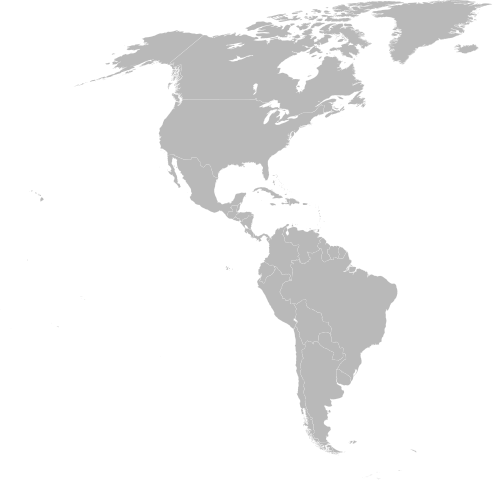
This is a map of the continental US (sorry, Hawaii: I’m on the lookout for a better Creative Commons image), within the context of North America (source):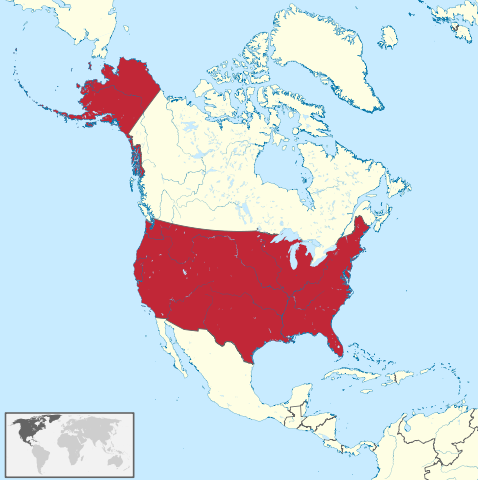
I hope that clears up any confusion about the terminology. ↩︎


Leave a Reply